
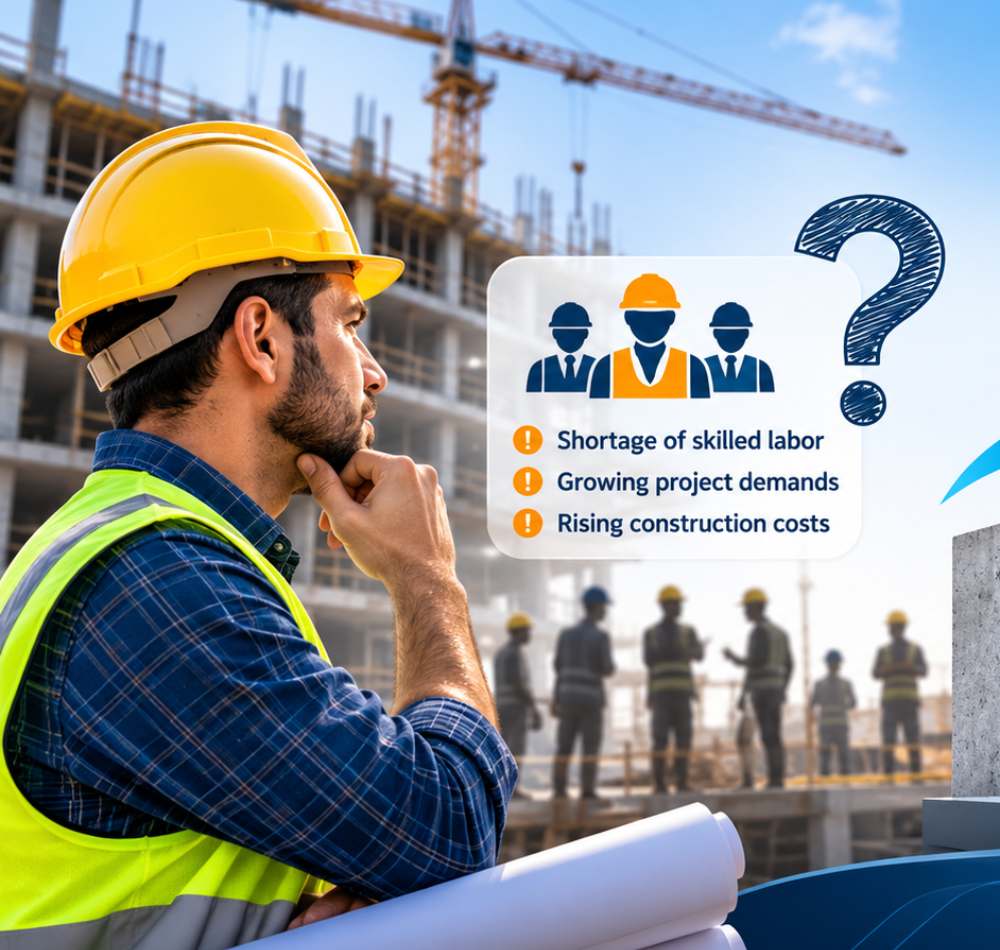
Let’s face it, no construction project can succeed, let alone progress smoothly, without skilled labour. However, India’s construction industry is currently facing a decline in skilled workers, raising concerns across the sector, particularly with numerous commercial and residential projects still in the pipeline. A labour shortage can disrupt even a well-planned project, making efficient construction solutions such as power grout increasingly valuable.
It can push project deadlines into indefinite hiatus and send costs through the roof. Faced with this challenge, builders and real-estate players in the industry have now turned their attention to smart building materials.
So, what are these “smart building materials,” and can they really bridge the skilled labor gap affecting India’s construction sector?
Those are the concerns we’ll be addressing in this article.
The Widening Skilled Labor Gap in Construction
A skilled labor gap would occur when there is a difference between the number of workers available and the number of workers needed to finish a project with the utmost efficiency. A typical construction project requires a variety of skilled labor. You’ll need labor for electrical installation, plastering, waterproofing, tiling, etc.
That said, construction methods have changed over the years. The workers you find today may not be capable or enough to meet the challenges that modern construction projects pose. So, it is not that India is facing a lack of labor; what it is lacking is a workforce skilled and trained to go toe-to-toe with modern construction challenges.
This problem is even more serious in a developing country like India that has witnessed rapid urbanization in the past few years.
Massive commercial and residential projects are underway across the country. Development on them can only reach its conclusion with a consistent availability of trained workers. Unfortunately, that is a requirement most companies are struggling to meet.
Key Reasons for Labor Shortage
One could attribute multiple reasons for the labor shortage we are seeing in construction today. We would highlight the following reasons as being prominent triggers:
- Falling Interest in Construction: Construction work isn’t child’s play. It can be physically punishing and mentally exhausting. So, it makes sense that younger talent is now scurrying away from the construction sector in favor of jobs in retail, manufacturing, logistics, etc.
- Constant Migration: Construction laborers often move from one city to another in search of a new gig. This has been a trend in India for ages, and it is a trend that we don’t see stopping anytime soon. This constant migration of labor has caused severe workforce instability, with contractors struggling to keep an experienced team on board for too long.
- Limited Training: It is not difficult to find labor that knows their way around traditional building skills that were probably passed down to them through experience instead of actual training. These traditional skills, however, fall short of what’s needed when handling advanced construction practices and high-end materials.
- Modern Project Complexity: Modern building endeavors have specific demands that must be met without compromises. This entails better durability, excellent finishing, and compliance with relevant regulations. These demands can only be met with specialized skills.
Smart Building Materials as a Possible Solution
When we talk about smart building materials, we aren’t talking about high-tech products with digitized components. We mean something along the lines of pre-engineered, ready-to-use, eco-friendly building materials developed through extensive R&D.
With traditional construction, workers had to spend an ample amount of valuable time and effort on ensuring that everything from mixing to application and curing is done efficiently.
Imagine the time, money, and work that can be saved with a product that streamlines tasks like measuring, mixing, and curing on site.
Simply put, here’s how smart building materials can positively impact a typical construction project:
I) Significantly Reduced Prep-Time
Preparing materials is undoubtedly time-consuming. It is also a process susceptible to human error. Having a smart building material that comes pre-engineered and ready-to-use right out of the bag can considerably simplify the preparation process.
With a large chunk of the preparation process already taken care of, workers can simply focus on the actual application part, skipping the pre-prep steps and saving a ton of time. This means boosted productivity and a real chance of projects being completed within the set deadlines.
II) Lasting Installation with High-End Tile Adhesives
The integrity of the tiled surface depends largely on the adhesive used. Poor quality adhesives can not only cause you a lot of grief during installation but also result in several problems down the line, like hollow spaces and cracks.
This is a problem you avoid by using polymer-modified tile adhesives. These tiles are engineered to guarantee a strong bond between the tile and its substrate. You can expect lasting durability, superior workability, and little to no complications during installation.
III) Excellent Finishing with Pre-Engineered Grouts
Grouting demands consistency and precision, two requirements that traditional building materials fail to meet. Pre-engineered grouts formulated through extensive R&D paint a different story. These substances are designed to guarantee consistency when it comes to performance and strength.
High-end grouts developed by manufacturers that prioritize innovation are known to exhibit resistance to chemicals, moisture, and stains. This consistency can help workers or teams working on a construction project ensure that finishing standards remain uncompromised across projects.
IV) Reduced Mistakes in Application
Most mistakes are made in the initial stages of construction. For instance, if surface prep was undertaken recklessly, the consequences will be felt years down the line when cracks and peels start making their presence felt.
Smart building materials can avert this disaster. An advanced primer or bonding agent can significantly improve bonding strength.
V) Reducing the Risk of Repair and Maintenance
The cost of labor shortage becomes much more apparent when rework or maintenance is needed, which is often the case when tasks weren’t performed well the first time around. This means builders need to compel workers to spend additional hours on site on maintenance and rework.
This is a risk builders and contractors can avoid or considerably mitigate by employing smart building materials. A pre-engineered plaster or tile adhesive assures better durability, crack resistance, and excellent workability, thus reducing the risk of maintenance work in the near future.
Conclusion
While the construction industry’s labor shortage problem cannot be solved by smart building materials alone, it can still resolve a lot of issues stemming from this gap.
Manufacturers can come to the rescue by providing materials that are easier to handle while contractors invest in training workers to adopt modern technologies and practices.
At Magnus Ventures, we are doing our part in helping India’s construction industry meet a widening skilled labor gap by offering innovative products in the form of eco-friendly tile adhesives, ready-mix plasters, grouts, and more.
We suggest you give our catalog a look and get in touch with us if you have any queries.