As the demand for sustainability grips the construction industry, green buildings are becoming a fundamental part of the conversation, with developers partnering with responsible eco-conscious vendors like sustainable tile grout suppliers to ensure eco-friendly living spaces. You can already see a shift towards green buildings in projects across India, where it isn’t hard to find residential complexes that feature solar panels or facilitate rainwater harvesting.
With more people becoming environmentally conscious, builders are also scurrying to get green building certifications.
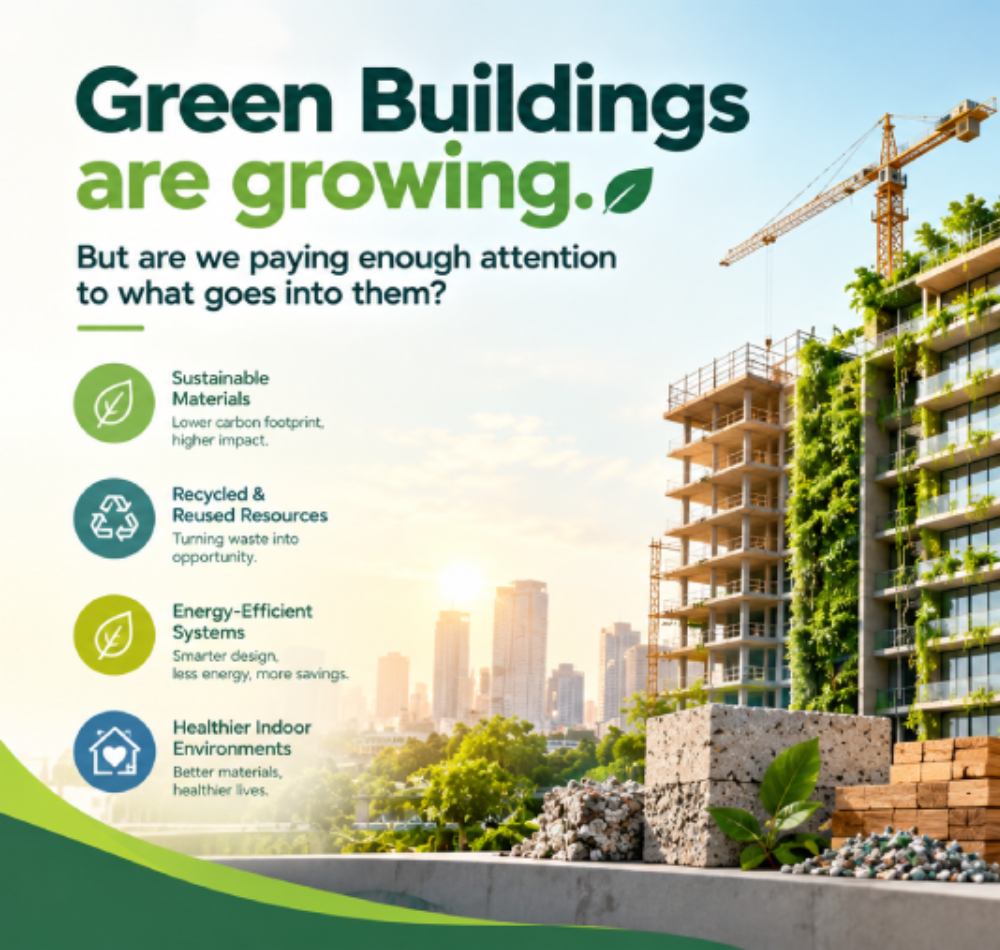
Amidst this welcoming trend, we might be overlooking a very important question. Is a building truly green if the materials used in it negatively impact the environment?
If our goal is to adopt sustainability, we must pay special attention to everything that goes into building a structure.
The Undeniable Popularity of Green Buildings
India’s construction industry is booming, as evidenced by the high demand for residential and commercial complexes across major cities. This boom comes at a very precarious time as the world deals with the existential crisis of climate change. Almost all of India’s major cities are among the most polluted in the world.
So, the popularity of green buildings should come as no surprise to anyone, especially those who are living in these heavily polluted cities. Green Buildings, by their very nature, are designed to reduce the impact of construction on the environment. They are defined by features like energy-efficient lighting, proper ventilation, and renewable energy systems.
Although we find this popularity encouraging, you need to understand that there is more to sustainability than saving energy or water. You may have a building that’s energy-efficient and yet triggers carbon emissions.
If true sustainability is to be accomplished, one must look at the construction process in its entirety, starting right from materials procured to build a structure.
Do Not Overlook the Environmental Cost of Building Materials
When a builder or contractor ventures out in search of the right materials for their project, they’ll rightfully consider a bunch of factors. This includes deliberating on the product’s price, availability, durability, and strength.
While these are all important factors to consider, there is one more thing that you cannot afford to ignore: the material’s environmental cost.
Take cement, for example, a very important part of any construction project. Manufacturing cement is resource-intensive. A lot of energy goes into producing cement, which results in substantial carbon emissions.
Now, cement itself isn’t inherently unsustainable. You still need it for construction. The real challenge here lies in finding a way to reduce this material’s overall carbon footprint. With today’s technology, that is possible.
Then we also need to talk about the waste generated on construction. Broken bricks, rubble made of concrete, discarded tiles, etc. are all examples of waste that can pile up on construction sites. If this waste isn’t properly recycled, it will be dumped in landfills or other disposal sites.
If this waste is dumped, builders end up losing useful material and also have to incur more expenses to procure new raw material.
The wiser thing to do here would obviously be to upcycle the waste.
How to Pick the Right Building Material
The path to sustainability begins from the very onset of a construction project. It is very imperative that developers and builders take material selection seriously if they truly want to develop a green building.
Here are a few things you can do to pick the right building material:
1. Pick Products that use Recycled Waste
Manufacturers that use recycled waste to produce raw materials are rare. We suggest opting for such materials, and you will be contributing to the principles of sustainability. When you do get in touch with a manufacturer that offers you such products, do ask them how they were tested and processed.
2. Assess the Material’s Durability
An eco-friendly product does not mean it is also durable. You want a building material that incorporates upcycled ingredients while also exhibiting high-end properties. For instance, if you are looking for a tile adhesive, make sure it promises you superior bonding strength. Products that are highly durable don’t need frequent repairs, thus adding to your building’s longevity.
3. Ease of Application and Workability
You want a building material that is easy to use and promises superior workability right out of the bag. This will ensure proper storage and installation with little to no mishaps during the actual application. This is necessary to avoid unnecessary material wastage on site.
4. Look for Evidence of Eco-friendliness
Don’t just take the manufacturer’s word at face value. Judge by credible evidence. A true eco-friendly building material must feature relevant certifications that prove its commitment to eco-friendliness. For instance, the products manufactured by Magnus Ventures carry GRIHA and IGBC certification. Look for such certifications to invest in reliable products.
5. Judge by the Overall Cost
When buying a material, don’t just look at the initial price you will pay. You need to also consider the investment you may have to make later on due to maintenance, repairs, and waste management. A product that promises excellent bonding strength and exhibits properties like moisture and weather resistance will end up being more cost-effective in the long run.
Finding the Right Manufacturer
It can be hard to pinpoint a single manufacturer when you have a plethora of options at your disposal. There isn’t a manufacturer out there that doesn’t boast about their product. How do you know that their products are actually green?
You need to look for manufacturers that have been in the industry for decades, serving clients both big and small across the country. That kind of substantial experience is a testament to the goodwill a manufacturer has earned over the years.
You’ll also need to take a deeper look into the manufacturer’s way of working. Manufacturers that indulge in extensive R&D with a special emphasis on innovation are definite green flags.
Finally, you’ll need to look into the manufacturer’s product catalog. Those who are transparent with their product’s composition, lifespan, and specifications are worth your time and money.
We at Magnus Ventures take pride in being a company that abides by those principles. We are one of those rare building material manufacturers in India that are vehemently committed to sustainable development practices. We want to guide India’s construction industry onto the path of sustainability with reliable, high-end, eco-friendly products.
We are home to tile adhesives, ready-mix plasters, and grouting solutions among many products that were manufactured by upcycling industrial waste.
We understand that a true green building isn’t one that proves to be energy-efficient after it is built. It is one that is incorporated with eco-friendly resources and materials from inception.