India is developing at a pace that’s unprecedented, as evidenced by its booming construction industry and expanding skyline. It is not uncommon today to see massive infrastructural projects and ambitious commercial hubs underway across the country’s urban and rural regions.
However, it would be naïve to assume that this development has come without a cost. Rapid development has significantly increased the demand for resources such as sand, cement, and bricks, putting considerable pressure on the country’s natural resources. Using alternatives like ready made plaster for walls can support more efficient construction practices, but the environmental impact of sourcing raw materials remains a concern that India can no longer afford to ignore.
So, what does that mean for the construction industry and India’s growth? Do we just stop building?
Of course not! India is in desperate need of better infrastructure and housing, but this development cannot come at the cost of its already vulnerable ecosystem.
One way to prevent this crisis would be to continue developing while finding a way to keep industrial waste at bay.
With companies like ours (Magnus Ventures) finding a way to manufacture building materials via upcycled waste, this seems to be the best solution to our problem yet.
The Environmental Impact of Accelerated Development
If India wants to stand on the global stage with its head held high, the country needs better infrastructure. More buildings will raise the demand for materials like steel, brick, and cement. Producing or acquiring these resources will in turn demand more energy and natural resources.
Exploiting the country’s natural resources to acquire these materials will lead to increased carbon emissions and pollution. As you can see, it is a chain that leads to a catastrophic problem.
So, we cannot stop builders and the construction industry at large from building. It is high time we realize that “building too much” was never the issue. Instead, the construction industry needs to look at waste management from a different, more innovative lens.
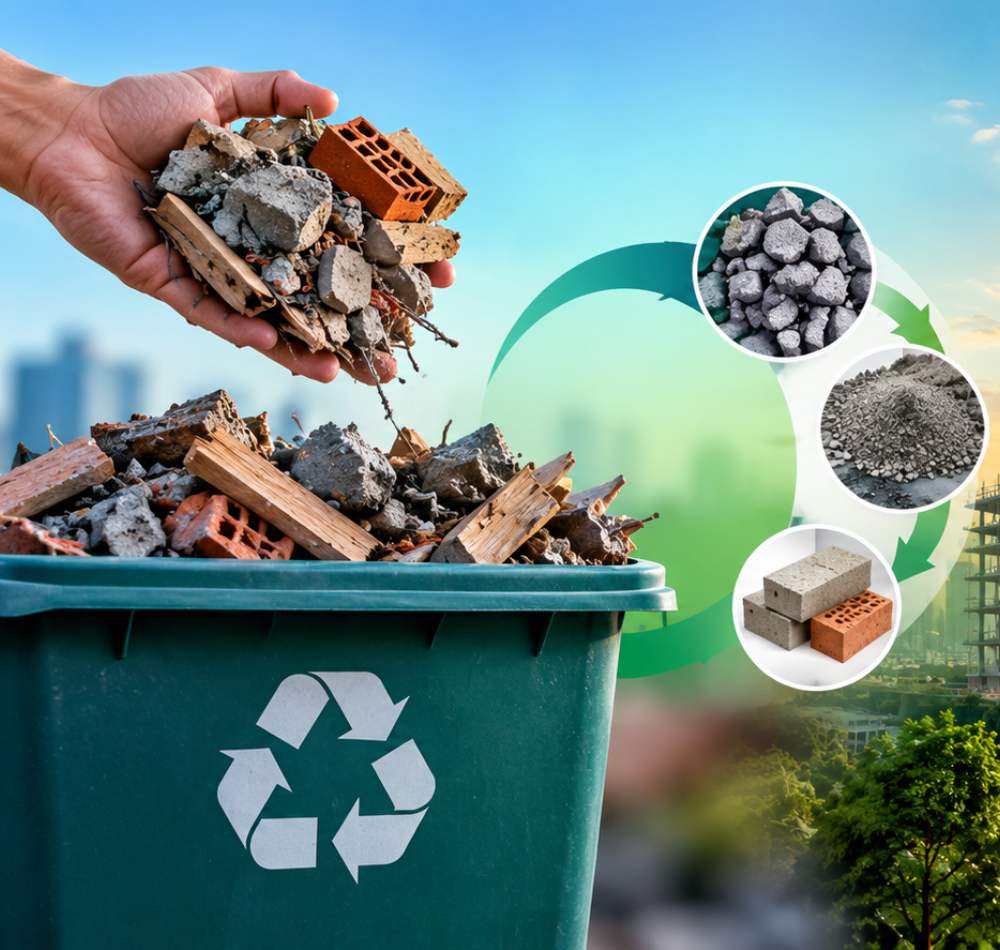
Instead of treating industrial waste as something to be dumped, why not find a way to make more construction material out of it?
Manufacturing Building Materials out of Industrial Waste
Industrial waste can be best described as leftover material from an array of industrial activity. It is estimated that India generates 100 million tons of Industrial waste each year. We now have the science and technology necessary to manufacture certain types of products from this waste.
Fly ash is a great example of such a product. A leftover from coal-based power generation, Fly ash is an ingredient used in the manufacturing of cement products and certain types of bricks. With some due diligence, you’ll also find examples of builders using recycled concrete for construction in some parts of the country.
These examples show us just how fruitful the prospect of upcycling or recycling industrial waste can be. Armed with the right technology and processing capabilities, Industrial waste can be turned into an invaluable resource.
You don’t have to look any further than the catalog of Magnus Ventures to know this is true. Over the years, we’ve mastered the art of manufacturing building materials like tile adhesives and ready-mix plasters from upcycled industrial waste.
The Benefits of Upcycling Industrial Waste
The overarching benefits of recycling industrial waste should be obvious to you by now. As for those in the industry still skeptical or hesitant to take this approach, the following benefits should convince them to abandon their stubbornness.
1. Overall Reduction of Waste
As industrial waste is recycled to create new products, fewer materials are sent to landfills and disposal sites. As such, waste that was originally supposed to be discarded has now found new value.
2. Reduced Exploitation of Natural Resources
With industrial waste being reused, it can serve as a replacement for newer raw materials, which one would acquire through means like sand mining or riverbed excavation. Both of these methods can put a strain on the ecosystem.
3. A Path to Innovation
As manufacturers continue to reuse industrial waste, they are bound to find ways to produce products with better properties. This not only creates new business opportunities but also sets the construction industry on a path of sustainable development, which is the need of the hour.
The Responsibility of Manufacturers
Ultimately, whether this approach of upcycling industrial waste catches fire depends entirely on building material manufacturers. Only through their efforts can sustainable development become a reality in this country.
You can’t just decide to turn waste into reliable products and start work tomorrow. It requires deliberation, extensive R&D, rigorous testing, and a team of professionals who know what they are doing.
Manufacturers must also work hand-in-hand with architects, engineers, and builders to create products that will benefit the construction industry at large. For instance, a builder might be interested in using a particular type of plaster. He or she may also want to know whether it will be compatible with a certain type of surface or whether it can withstand heavy traffic.
Manufacturers should also be as transparent as possible with their prospective buyers. Their products should feature valuable information with specifications clearly laid out. Manufacturers must first build trust, and only then will they be successful in pushing sustainable building materials into the mainstream.
The Bottom Line
Simply put, India will continue to grow as a country with new infrastructure and building projects in the pipeline. The question we need answered is how this development can take effect without harming the environment.
One possible solution to this conundrum lies in using industrial waste to build new construction materials. This will not only reduce our dependence on traditional raw materials and reduce waste, but also prevent damage to India’s already vulnerable ecosystem.
After all, India’s next construction revolution may begin with what we throw away.
Of course, simply producing products from upcycled waste won’t suffice. The construction industry needs products that reduce waste but do so without compromising on quality.
That is where we at Magnus Ventures come into play. With 41 years of experience under our belt, Magnus Ventures offers a wide range of eco-friendly products that can usher India’s construction industry onto the path of sustainability.
Magnus Ventures Succeeds Where Others Have Failed
At Magnus Ventures, we pride ourselves on being one of those rare Indian building material manufacturers to have successfully found a way to harvest industrial waste. Our products, be it grout, tile adhesives, or ready-mix plasters, were all manufactured via upcycled waste.
We don’t just offer eco-friendly building materials. Each product in our catalog serves as a testament to innovative manufacturing bolstered by extensive R&D. What we offer you are reliable construction solutions that promise exceptional bonding, durability, and strength.
If you too are keen on joining the revolution, we suggest getting in touch with our team today.